Thursday, January 30, 2014

People in the News


HB9RS (SK)
(From 4U1UN website)

Two prominent hams became Silent Keys in December and January. The ARRL Letter reports that Max de Henseler, HB9RS, the founder and president emeritus of United Nations Radio Club, 4U1UN, passed away at age 80 on December 30. The club originally held the U.S. call sign of K2UN - which it still uses for operations outside the UN Headquarters complex - and de Henseler personally persuaded the Secretary General in 1978 to approve the use of the 4U1 prefix and to authorize the use of 4U1UN for the headquarters ham station (which has been off the air since 2010 due to renovation of the Secretariat building).


CQ DX Hall of Fame member and former WorldRadio columnist Jack Troster, W6ISQ, became a Silent Key on January 11, according to an announcement by Northern California DX Foundation (NCDXF) President Rusty Epps, W6OAT. Troster was one of the co-founders of NCDXF in 1972. He was elected to the CQ DX Hall of Fame in 1988.


Ten-Tec CEO Jack Burchfield, K4JU, turned over responsibilities for the manufacturer's day-to-day operation to company president Jim Wharton, NO4A, as of January 1. According to the ARRL Letter, Wharton says Burchfield will remain CEO and the company's majority stock holder, but plans "to begin retiring and spending more time with his family."

Ham TV Commissioning on Space Station


The digital amateur television (DATV) transmitter aboard the International Space Station is due to be commissioned over a period of several weeks in February and March, according to the ARRL. Commissioning will be done in several stages by Astronaut Mike Hopkins, KF5LJG. Once active, the station will downlink digital video signals on 2.395 GHz, beginning with a 25-day continuous transmission of a blank video signal (with no camera attached). However, decoding the signal should result in the channel name "HAMTV" appearing on the screen. For updates and more information, visit the ARISS-Europe website at <www.ariss-eu.org/>.

NASA Photo


Also on board the ISS are four amateur radio cubesats, which were delivered by a resupply rocket in early January. According to the AMSAT News Service, LituanicaSat-1, LitSat-1, ArduSat-2 and UAPSat-1 are all scheduled to be deployed from the space station in the coming months. LituanicaSat-1 carries an FM transponder and a packet digipeater (2-meter uplink; 70-centimeter downlink for both) and a 70-cm. CW beacon. LitSat-1 is believed to have a linear transponder for SSB/CW communications, with uplink on 70 centimeters and downlink on 2 meters. UAPSat carries a packet digipeater (2m up, 70 cm down) and ArduSat - an Arduino-based satellite - will be downlink-only, transmitting digital signals on 70 centimeters.

Yasme Foundation Honors Nine


Nine hams who, "through their own service, creativity, effort and dedication, have made a significant contribution to amateur radio," have been awarded the Yasme Excellence Award for 2013, according to the Yasme Foundation.

The new honorees are: Tom Roscoe, K8CX, for his "Hamgallery" history website; Lee Sawkins, VE7CC, for writing filtering software for the DX Cluster spotting network; low-band authority John Devoldere, ON4UN; a group of four hams who have helped make FCC database information readily available - Michael Carroll, N4MC; Eldon Lewis, K7LS; Dean Gibson, AE7Q, and Joe Speroni, AH0A; ham video producer Ken Claerbout, K4ZW and Ashraf Chaabani, 3V/KF5EYY, who is leading an effort to bring individual amateur licensing to Tunisia, and serving as a representative for amateur radio throughout northen Africa.

Each awardee receives a cash grant and an engraved crystal globe.For details, visit <www.yasme.org>.

Repeater Owners May Now Submit Directory Updates Directly to ARRL


In a reversal of a long-standing policy, the ARRL says repeater owners may now submit updated information for their ARRL Repeater Directory listings directly to the ARRL. Past policy had required that updates come only from frequency coordinators.

ARRL Publications Manager Steve Ford, WB8IMY, stressed to the ARRL Letter that this is not a substitute to sending updates to your local coordinator, but rather only a streamlined process for keeping the Repeater Directory up to date. "It also isn't a substitute for formal coordination of a new repeater," he added. "Only repeater coordinators can do that."

Antique Radio Classified Returns as Hybrid


Antique Radio Classified, which has not published in several months due to rising printing and postage costs, has returned as a hybrid digital-print publication. Publisher Jon Kummer, WA2OJK, says the magazine is being published monthly online, effective with the February issue; with each three months' worth of issues then combined into a single print issue that will be mailed to subscribers. For more information, see <www.antiqueradio.com>.

Update: Voice of Russia Remains on Shortwave


We previously reported that the Voice of Russia (formerly Radio Moscow) had ended all shortwave broadcasts as of January 1, 2014. In early January, the ARRL Letter reported that shortwave listener and blogger Tom Witherspoon, K4SWL, had heard directly from the broadcaster that "the Voice of Russia will stay on the air in 2014." However, it said there would be "considerable changes in our frequency schedule." Most of the station's transmissions are now aimed toward the Middle East and Asia.

Thursday, January 2, 2014

Unrest in South Sudan Silences Ham Operators


Flag of South Sudan (CIA World Factbook)
The two licensed amateurs in South Sudan both report that they have taken their stations off the air and shipped their equipment out of the country "in order to avoid misunderstandings" with either side in the growing ethnic conflict that as of late December had claimed over a thousand lives. According to a report on the ARRL website, Massimo Stella, Z81B (also IZ0EGB), and Diya al Asadi, Z81D (YI1DZ), said they expect to be off the air "for a while." Stella was in Europe while al Asadi remained in South Sudan.

Both of them had been part of the Z81X operation from South Sudan in November, along with CQ DX Editor Wayne Mills, N7NG, who reports on that expedition and associated activities in his column in the February issue of CQ. (Please note that Wayne filed his column prior to the outbreak of violence in the country).

Radio Arcala Tower Collapses in Storm


The massive 330-foot tower supporting the 160- and 80-meter Yagis at Radio Arcala's OH8X contest station in Finland collapsed under high winds in an early December storm that left some 200,000 families in the country without power. The 3-element 160-meter beam was reportedly the world's largest amateur radio antenna.


According to the ARRL Letter, group spokesman Jarmo Jaakola, OH2BN, speculated that the automation designed to enable the array "to find its most comfortable position in high winds" may have locked up and caused the structure to corkscrew. Jaakola said the tower - featured on the cover of the November 2011 cover of CQ - collapsed "peacefully" and caused no damage to any people or surrounding structures. At press time, inspectors were still trying to determine the exact cause of the failure.

Communications Act Update Planned


Rep. Fred Upton (R-MI),
Chairman of the House
Energy & Commerce
Committee.
(House of Reps. Photo)

Rep. Greg Walden, W7EQI, Chairman of the Communications
and Technology Subcommittee (House of Reps. Photo)
Citing the need for the law to keep pace with rapidly-changing communications technology, the two Congressmen in charge of telecommunications policy in the House of Representatives say they are planning a comprehensive review and update of the Communications Act. Representatives Fred Upton (R-MI) - Chairman of the House Energy and Commerce Committee - and Greg Walden, W7EQI (R-OR) - Chairman of the Communications and Technology Subcommittee - say the effort will take over a year. Walden said the Communications Act - first passed in 1934 and last updated in 1996 - is now "painfully out of date" and said the committee's goal is "to make sure this critical sector of our economy thrives because of the laws around it, not in spite of them." No timeline was given in the committee's announcement.

Listen for W100AW


The ARRL has been authorized by the FCC to use the special callsign W100AW during 2014, the League's centennial year. According to the ARRL Letter, the special call will be used in addition to W1AW, depending on the circumstance. 

Contacts made from the Maxim Memorial Station at ARRL Headquarters will use W100AW, as will those from regional conventions and during the IARU HF Championship this summer. However, regular bulletins and code practice transmissions will still use W1AW, as will stations operating in the "W1AW WAS" program from each of the 50 states.

Solar Scientists: Cycle 24 Weakest in a Century


NASA Image
The current solar cycle is the weakest of the past ten cycles, according to four solar scientists reporting on "space weather" at the fall meeting of the American Geophysical Union. The ARRL Letter reports that the four -- Nat Gopalswamy and Martin Mlynczak of NASA, Stanford's Leif Svalgaard and Joe Giacolone of the University of Arizona - say a weak polar magnetic field during Cycle 23 is thought to be the mechanism behind the weakness of Cycle 24. By continuing to track the polar magnetic field, said Svalgaard, it should be possible within a few years to predict the robustness (or lack of robustness) of Cycle 25. The group did not directly address the impact of the current weak cycle on radio propagation.

Voice of Russia Leaves Shortwave


Many hams who came of age during the Cold War recall listening to the thinly-disguised propaganda broadcasts of Radio Moscow booming in on their shortwave receivers. 

After the fall of the Soviet Union, the station was renamed the Voice of Russia but maintained a busy shortwave broadcast schedule. It began cutting back last year, though, and as of January 1, 2014, eliminated all shortwave broadcasting. The station will continue to reach out to international audiences via medium-wave broadcasting and the internet.

Astronaut-Hams Fix ISS Cooling System


Two American astronaut-hams repaired the International Space Station's cooling system during a dramatic Christmas Eve spacewalk, replacing a failed ammonia pump. According to Newsline, astronauts Mike Hopkins, KF5LJG, and Rick Mastracchio, KC5ZTE, each took two spacewalks as part of the repair mission -- removing the faulty pump on December 21st and installing a new one on the 24th. The astronauts were outside the station for more than seven hours, in part because an ammonia fluid line sent frozen flakes of the substance right at them, with some sticking to their spacesuits. They had to wait until the ammonia on their suits dissipated before re-entering the station, to avoid possible contamination.

Lt. Gen. Susan Helms, KC7HNZ
(US Air Force Photo)
In a related story, the ARRL Letter reports that former astronaut Susan Helms, KC7HNZ, has renewed her interest in amateur radio, regaining both her license and her callsign, which she'd allowed to expire in 2005. Helms, a Lieutenant General in the Air Force, is now the senior officer at Vandenberg Air Force Base in California. Her interest reportedly was reignited by an activity hosted by the Satellite Amateur Radio Club, W6AB, for Scouting's 2013 Jamboree on the Air. During a tour on the International Space Station in 2001, Helms used NA1SS for the first ARRL Field Day operation from space.

Hams Say "HI" to Juno Spacecraft


The Juno spacecraft is headed for Jupiter.
(NASA image)
Hams around the world made coordinated transmissions last fall on 10 meters, sending "HI" in very slow Morse code to the sensors on the Juno spacecraft as it swung past Earth for a gravity boost on its journey to Jupiter. A video on the activity has been produced by NASA's Jet Propulsion Laboratory and is available on YouTube at <http://bit.ly/18PeGcI>. A more detailed article on the activity is planned for the March issue of CQ Plus.

Ham Industry Changes


News of note from the ham radio industry:

UK-based InnovAntennas has acquired Force 12 antennas of Bridgeport, Texas and consolidated its manufacturing activities with InnovAntennas America's facility in Grand Junction, Colorado. According to the InnovAntennas Facebook page, the combined facility "is in full swing and we are shipping, building and shipping antennas … daily."


At the end of December, Japanese amplifier manufacturer Tokyo Hy-Power filed for bankruptcy and closed its manufacturing plant near Tokyo. The company's main website has also been closed down, although its US website remains active. According to a report on the ARRL website, company President and CEO Nobuki Wakabayashi, JA1DJW, said "the recent depression in the industrial RF power products area has led to the very difficult financial position."


CQ Communications has realigned its publication lineup, merging Popular Communications, CQ VHF and WorldRadio Online into CQ Plus, a supplement to the digital edition of this magazine, effective with this issue. See below for more information, as well as individual magazine websites and the January issues of CQ and WorldRadio Online.
 

2014-2018 Technician Question Pool Released


The National Conference of Volunteer Examiner Coordinators has released the question pool that will make up Technician Class amateur radio license exams between July 1, 2014 and June 30, 2018. Newsline reports there was a brief mixup when the pool was first published on December 10, and that corrected questions were posted two days later. The new pool may be downloaded from <http://tinyurl.com/tech-questions-2014>. Exams given between now and June 30 will continue to be composed using the 2010 question pool currently in use.

K4ZDH Honored by Radio Club of America


Riley Hollingsworth, K4ZDH, as pictured on the cover of
CQ in January, 2000 (Larry Mulvehill, WB2ZPI, photo)
Retired FCC Special Counsel and CQ columnist Riley Hollingsworth, K4ZDH, has been honored with the Radio Club of America's Sarnoff Citation for 2013. The citation recognizes individuals for "significant contributions to the advancement of electronic communications." It has been given annually since 1973.

50 New Hams Licensed in Kosovo


Flag of Kosovo (Courtesy CIA World Factbook)
The airwaves should be busier with callsigns from Kosovo, as 50 young Kosovars between 18 and 21 years of age passed their license exams at the first-ever amateur radio exam under the new laws of the Republic of Kosovo. According to a posting on the Southgate Amateur Radio Club's news page, the exam session at the Technical University of Pristina was supervised by members of the Exam Commission as well as International Amateur Radio Union Region 1 President Hans Blondeel Timmerman, PB2T and Project Goodwill Kosovo leader Martti Laine, OH2BH. 
 
Hams around the world are asked to help cover the costs of these exams, which at 50 Euros ($70US) per person, are significant expenses for young people in Kosovo. A Paypal account has been set up via <www.qrz.com/db/Z60A> for donations. Contributors will be assigned an amateur radio "grandchild" and provided a photo and other information about the new ham they are sponsoring. Several DX organizations have already pledged support. For more information, contact PB1T (president@eudxf.eu) or OH2BH (oh2bh@sral.fi).

Friday, December 27, 2013

CQ to Realign Publications, Launch New "CQ Plus" Digital Supplement


CQ Communications, Inc. today announced plans to realign its roster 
of publications and to launch an exciting new online supplement to its 
flagship magazine, CQ Amateur Radio. 
 
"The hobby radio market is changing," said CQ Communications 
President and Publisher Dick Ross, K2MGA, "and we are changing 
what we do and how we do it in order to continue providing leadership 
to all segments of the radio hobby." CQ Communications is currently 
the only publisher in the United States serving the broad radio hobby, 
from broadcast band DXing to amateur radio moonbounce and satellite 
communications. CQ itself has been amateur radio's leading independent 
voice for seven decades. 
 
Effective with the February 2014 issue of CQ, said Ross, content from 
the magazine's three sister publications, Popular Communications, 
CQ VHF and WorldRadio Online, will be incorporated into CQ's digital 
edition as a supplement to be called "CQ Plus." With this change, hobby 
radio enthusiasts of all types will be able to go to a single source - CQ - 
for articles on the broader aspects of hobby radio, from shortwave 
listening and scanner monitoring to personal two-way services and Internet 
radio, as well as amateur radio.  Richard Fisher, KI6SN, currently Editor
of both Popular Communications and WorldRadio Online, will be Editor 
of CQ Plus.
 
"Our primary audience is ham radio operators," explained Ross, "but very 
few hams began their radio involvement as amateurs. Most of us started out 
as shortwave listeners, broadcast band DXers, CBers or scanning enthusiasts. 
Many continue to be involved in many different aspects of the radio hobby in 
addition to amateur radio." 
 
"By consolidating four specialized publications into one," Ross continued, "we 
will be better able to keep these multidimensional readers informed on all 
aspects of the radio hobby while simultaneously exposing those who are 
not hams to all the excitement and opportunities that amateur radio has to 
offer. We see this as a win-win for all of our readers and our advertisers, 
who will now be able to reach a wider and more diverse audience."

The expanded material will be an integral part of the digital edition of CQ, 
and will be included as part of a standard digital subscription. Each month's 
digital edition will simply continue beyond where the print edition ends, 
offering supplemental material on all aspects of hobby radio communication 
and will include selected columns carried over from the other magazines. 
The added digital content will make full use of the multimedia opportunities 
presented by digital publications. 
 
Current subscriptions to Popular Communications, CQ VHF and 
WorldRadio Online will be converted to CQ subscriptions - and receive  
CQ Plus at no additional charge! Details will be posted on each magazine 
website.
 
There's no need to wait to see the great variety of articles that will be 
featured each month in the new CQ and CQ Plus. A preview of the February 
issue's Table of Contents is available right now on the CQ website 
at <http://bit.ly/19mzbOK>.
 

Thursday, November 21, 2013

Update: FUNcube, Other Satellites in Orbit

AMSAT-UK's FUNcube-1 is now in orbit, renamed AMSAT-OSCAR 73.

The ARRL Letter reports that FUNcube and 18 other satellites were successfully launched today on board a Russian Dnepr rocket. One of the other satellites - UniSat-5 - will deploy additional satellites, including several that will operate on the ham bands.

Initial reports are that AO-73 is operating normally. The latest orbital elements for FUNcube-1 are available at http://funcube.org.uk/working-documents/latest-two-line-elements/.


Hams Pitch In After Philippine Typhoon


Max Santos, 4F1BYN, copies health and welfare
messages from the storm-ravaged city of Tacloban
on 40 meters. (DU1VHY photo)

Like hams everywhere, amateur radio operators in the Philippines were able to get on the air after Typhoon Haiyan and provide initial communications after the storm destroyed much of the infrastructure in Tacloban and surrounding areas. Communications were coordinated by the Philippine Amateur Radio Association's "Ham Emergency Radio Operators," or "HEROs" program.

In the accompanying photo, Max Santos, 4F1BYN, operating at the station of DU1DL in Antipolo, copies health and welfare messages on 40 meters from Tacloban, one of the cities that suffered the greatest damage from the storm.

For detailed coverage, see our Public Service column -- "Radio HEROs Provide Critical EmComm in Philippine Typhoon Tragedy" -- in the upcoming January issue of CQ magazine  <www.cq-amateur-radio.com>.

Staff Shuffle at FCC Wireless Bureau


Communications attorney Roger Sherman is the new Acting Chief of the FCC's Wireless Telecommuni-cations Bureau, which oversees amateur radio as well as other two-way radio services. Sherman replaces former Bureau Chief Ruth Milkman, who was named Chief of Staff to new FCC Chairman Tom Wheeler.

According to the ARRL, Sherman previously served as the Democratic Chief Counsel to the House Committee on Energy and Commerce, along with other Congressional staff positions.

Hams Carry Olympic Torch to Space and Back


The 2014 Olympic torch aboard the International
Space Station (NASA photo)
Now this is a torch run!

The route from Greece to Sochi, Russia for the torch that will light the Olympic flame at next February's winter games in the Russian city included a round trip to the International Space Station … carried there and back by crew members who are nearly all hams.

The torch was taken up to the station in early November by the all-ham crew of Expedition 38 - Astronauts Richard Mastracchio, KC5ZTE and Koichi Wakata, KC5ZTA, and Cosmonaut Mikail Tyurin, RZ3FT. It was brought back several days later by returning Expedition 37 crew members, including Commander Fyodor Yurchikhin, RN3FI, and European Space Agency Astronaut Luca Parmitano, KF5KDP.

Parmitano was very active on amateur radio during his stay on the station, according to the ARRL Letter, conducting many school contacts as well as making more than 200 random contacts with hams back on Earth.

Olympic Games website: <http://www.sochi2014.com/en/>

More Ham Radio on TV … and More Hams Among Crew Members


Tim Allen (as Mike Baxter) operates ham radio along with
Flynn Morrison (Mike's grandson Boyd) on the November
22, 2013 episode of "Last Man Standing" on ABC-TV.
(Photo courtesy "Last Man Standing")
The November 22 episode of the ABC-TV comedy "Last Man Standing" includes a segment during which star Tim Allen (Mike Baxter, KA0XTT) gets on 20 meters and works a pileup of more than 100 hams! The responses had been previously sent in by hams in response to a request from Producer John Amodeo, NN6JA, for short audio clips.


In addition, the show's crew now includes 17 licensed hams, with eight new amateurs licensed during a November 9 exam session that also included one crew member upgrading to General. "Last Man Standing" airs Friday nights at 8 PM eastern time on ABC.

New LoTW Software Released


The ARRL has released version 2.0 of its TQSL software needed for accessing the Logbook of the World (LoTW) online QSO database. According to the ARRL Letter, the new release is completely new and incorporates the earlier TQSL-Cert into the single TQSL program. The user interface is also completely new, and the League promises the new software will be easier to use than past versions. Difficulties using the TQSL software have been among some of the problems plaguing the program recently. More information, including a link to download the new program, is at <bit.ly/HIw335>.

ARRL Petitions for "Symbol Rate" Change


The ARRL has filed a petition with the FCC, asking that it replace current limitations on "symbol rate" for digital modes on HF with a simple bandwidth limitation of 2.8 kHz. According to the League, this would permit the use on HF of any digital mode whose signals are no wider than a single-sideband voice signal. It says the current rules were designed for 1980s technology and are impeding technological progress by hams today. At press time, the FCC had not assigned the petition a rule-making number or opened it for comments.

WRC-15 Advisory Committee Makes Recommendations Regarding Ham Bands


The FCC's advisory committee for the 2015 World Radiocommunication Conference (WRC-15) has issued three recommendations regarding bands used by amateurs, and the ARRL says it agrees with all three. The first called for no changes to current allocations in the 70-centimeter band, which hams share with government radiolocation. ARRL Letter says one country has proposed allowing international cellphone and broadband use between 420 and 430 MHz, but the advisory committee said it does not feel sharing between the proposed service and radiolocation is feasible.
The

Likewise, the committee recommended no changes to current allocations on 22-26 GHz, a frequency range in which amateur radio has a primary allocation from 24-24.5 GHz.

Finally, the committee tentatively approved a proposal for short-range automotive radar in the 77.5-78.0 GHz range. If OKd by the conference, these radars would have co-primary status in the band with amateur radio and amateur satellites.

IARU Region 2 Updates Band Plan


A new band plan has been issued by Region 2 of the International Amateur Radio Union, which covers North and South America. Features include a new satellite subband from 144.000 to 144.025 MHz and the first formal recognition of "near space stations" (e.g., those operating from high-altitude balloons), although no specific frequencies were recommended for these operations. According to the ARRL Letter, the plan also includes suggested subbands for microwave ham bands and tries to harmonize the Region 2 band plan with those of IARU Regions 1 (Europe and Africa) and 3 (Asia and Oceania).

FUNcube and Other Ham-Band Satellites Head Spaceward


This month is prime time for tiny satellite launches, many of which will use the ham bands for communications or telemetry. A November 19 launch from Virginia sent 29 satellites into orbit, including TJ3Sat, the first satellite designed and built by high school students. TJ3Sat includes an amateur radio component (see <http://www.tjhsst.edu/students/activities/tj3sat/>).


A launch scheduled for November 21 from Russia was to send up another two dozen-plus "cubesats," tiny satellites that have become very popular among schools and hams alike. The ham radio "star" of the November 21 launch is FUNcube, a joint project between AMSAT groups in the United Kingdom and the Netherlands (see <http://funcube.org.uk/>).

In addition, four cubesats carrying ham radio payloads were planned to be deployed from the International Space Station on November 25. (ARRL and AMSAT News Service)

QRPMe to Produce Rock-Mite ][


The original Rock-Mite transceiver board.
(From Small Wonder Labs website)
The closing of Small Wonder Labs (see earlier post) left in doubt the future of the company's popular Rock-Mite QRP transceiver.

An announcement on the SWL website in mid-November said production of the rig -- with some modifications -- would be taken on by QRPMe, which announced the introduction of the "Rock-Mite ][." See www.qrpme.com.

Arizona Ham Uses Linked Repeater Network to Help Stranded Ham in Nevada


Map of WIN System linked repeaters
(from winsystem.org website)

When Nathan Rischling, KD0HFM, found himself stranded during a hike in the hills outside of Henderson, Nevada, his call for help on a repeater linked to the Western Intertie Network (WIN) was answered by Jim Frederick, KF6QBW, hundreds of miles away in Arizona.

According to the ARRL Letter, Frederick again used the WIN system to seek out a ham in the Las Vegas area. James Freeman, KG7EWP, answered that call and called 911 to alert a search-and-rescue team. Frederick reported that a few hours later, Rischling came back on the system to thank everyone involved in his successful rescue.

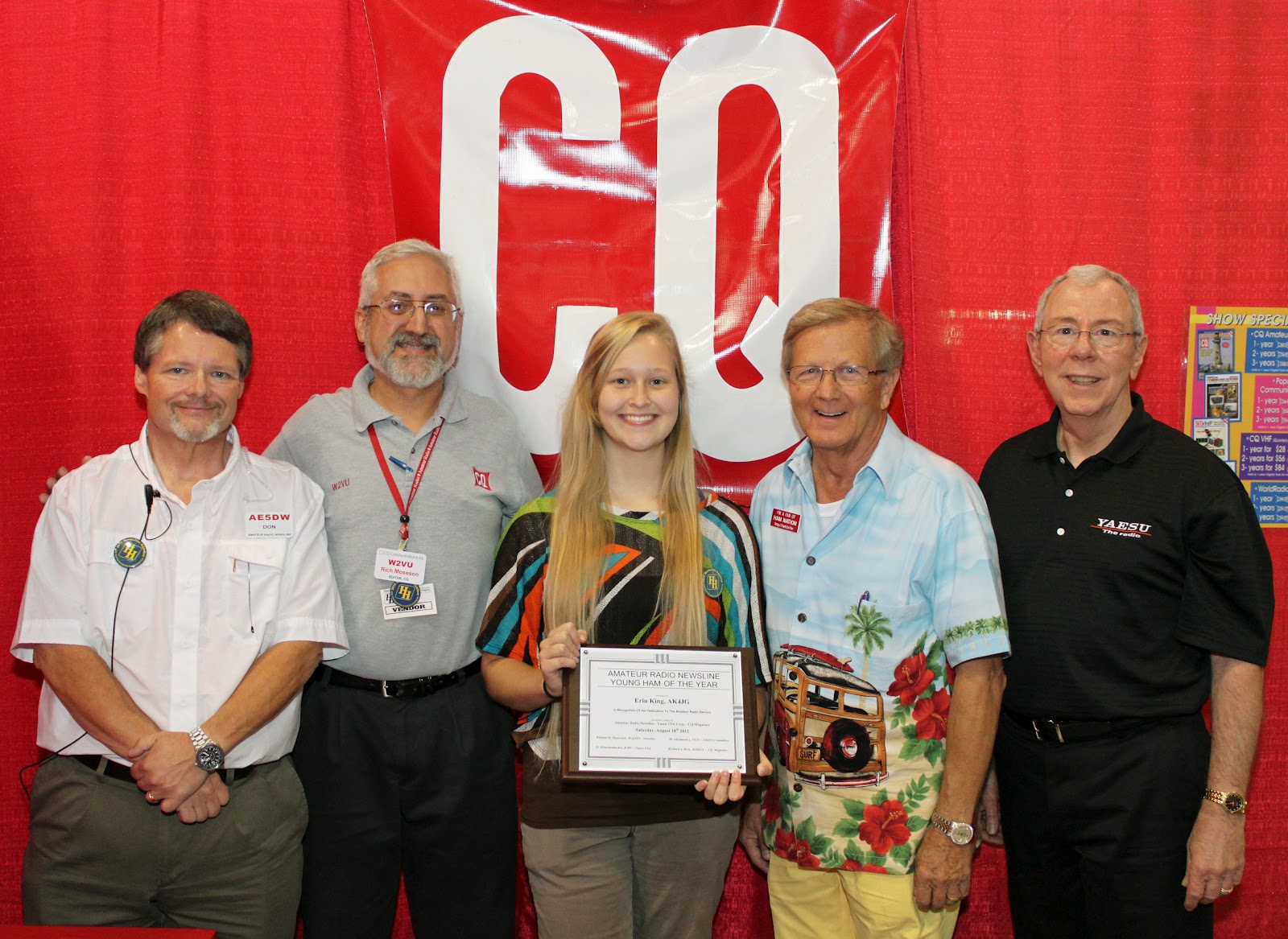
2012 Young Ham of the Year AK4JG Tabbed as One of World's Smartest Teens

Erin King, AK4JG (center), receiving the 2012 Newsline Young
Ham of the Year award at the Huntsville Hamfest. Also
pictured (from left): Newsline's Don Wilbanks, AE5DW;
CQ Editor Rich Moseson, W2VU; Bob Heil, K9EID, of Heil
Sound, and Yaesu's Dennis Motschenbacher, K7BV.
(K0NEB photo)

Erin King, AK4JG, the 2012 Newsline Young Ham of the Year, has been named by TheBestSchools.org as one of "The World's 50 Smartest Teenagers" (see <http://bit.ly/1gelyRI>. King's amateur radio activities were mentioned prominently in her profile.

She is currently a sophomore at MIT and spent last summer working with Google's Project Loon, which, according to Newsline, is an experiment using high-altitude balloons to bring Internet access to remote locations. (CQ is a corporate co-sponsor of the Newsline Young Ham of the Year program.)

N6CL to West Point


The Rev. Joe Lynch, N6CL
Congratulations to CQ's "VHF-Plus" Editor and CQ VHF magazine Editor Joe Lynch, N6CL, on his new position as Director of Religious Education at the United States Military Academy in West Point, New York. Lynch is a Methodist minister.

As this is posted, Joe and his wife, Carol, W6CL, are en route to West Point from Tulsa, Oklahoma. Joe plans to continue both writing his column and editing CQ VHF in his new position.


CQ VHF website:  www.cq-vhf.com

Unusual DX Opening on 6 Meters


A group of sunspots as seen by the
SOHO satellite on Nov. 9, 2013
(NASA photo)

Six-meter operators look forward to the peak of a sunspot cycle for occasional F2-layer band openings that permit intercontinental DX on "the Magic Band." The current Cycle 24, however, has been too weak to feature any of these openings  -- until November 9. The ARRL Letter reports that the 90-minute opening provided 6-meter ops across the U.S. the opportunity to work into the Caribbean and Central and South America. It's not the transatlantic or transpacific DX which occurred during the last sunspot peak in 2000-2001, but it's the best that the current cycle has offered so far.

The Art of Ham Radio … in Space


The ARTSAT2 DESPATCH satellite
(Courtesy ARTSAT-DESPATCH website)
The AMSAT News Service reports that students at Japan's Tama Art University are working on launching a piece of artwork - complete with a ham radio transmitter - into deep space in mid-2014. The sculpture/satellite, named ARTSAT2 DESPATCH, was created on a 3D printer and sill be launched into deep space as part of a mission to explore asteroids.

The vessel carrying the sculpture will also carry a low-power CW beacon operating on 435 MHz. It should reach its greatest operational distance from Earth - some 3 million kilometers or 1.8 million miles - about a week after it is launched, so receipt of those signals will represent a tremendous feat of QRP listening! For more information, see <http://tinyurl.com/ARTSAT-DESPATCH>.